Monday, November 28, 2011

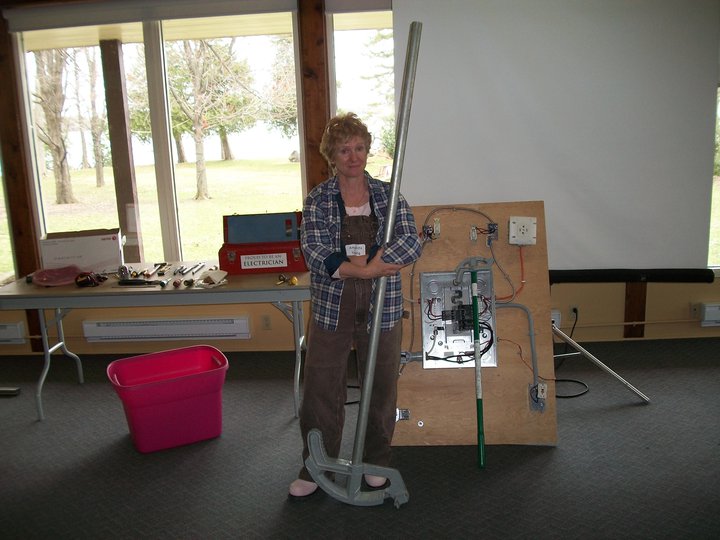
Skills Work!® for Women – Amanda Young, Electrician


Electrical work is hard.  There’s a lot of math and physics involved, the work can be quite physically demanding, and travel for work can be extensive.  But if you talk to Amanda Young, you’ll find that what can be the most challenging is working with so many different people.  Whether in a classroom or on a job site, the group dynamics are something that must be managed.  However, especially that she’s now teaching her trade, Amanda finds that the people are also the most enjoyable part of her job.

After trying floristry and early childhood education, Amanda’s desire for a higher income turned her attention to becoming an electrician.  After starting as a labourer, and then going through her electrical apprenticeship, she’s now had her ticket for about 10 years.  She’s worked on a variety of jobs over the years, even taking her to the oil sands in Alberta.

“It was amazing.  We were in an isolated area, but there were 2000 people working in the camp.  Hundreds of buses were transporting people back and forth all the time, all different shifts and all different trades.  And there were 6 camps like this.”  She also enjoyed getting to use tools and machinery that she never would otherwise have seen, and to travel to places she may not have visited.  For free, no less!

In recent years, Amanda has turned more toward teaching.  Over the past six years, she has taught intermittently at Georgian College, and now she is the Lead Teacher for the Electrical Techniques program at Georgian.  Not only is she responsible for her own classes, but three other teachers report to her, plus she has the responsibility of looking after program needs such as tools, materials, textbooks and curricula.  Amanda’s passion for teaching has provided her with a number of other opportunities to speak to youth about her career, including through the YMCA, WIST (Women in Skilled Trades) and Women on Words.

The most important thing to remember going into an apprenticeship is that it can be demanding.  You don’t always get to do what you want, but you need to learn what you can, and stick it out until you get to the point where you can pick and choose your jobs.  Math skills are important, and you need to be versatile.

Particularly for young women, Amanda's advice is this:  “be prepared for obstacles, and bring a positive attitude.  It’s easy to get dragged down by others’ attitudes and behaviours.  Try to look at your workmates as people, not just a bunch of guys.  If you have confidence in yourself, the people you work with will reflect that.”

Amanda was a mentor at this year’s “Skills Work!® for Women” Networking Dinner in Barrie on November 15, 2011.

Thursday, November 24, 2011

Skills Work!® What’s Out There?

Sheet Metal Workers

Normally, when people think of construction careers, the first to come to mind are carpenter, plumber or electrician. Construction is the largest sector in the skilled trades, so there are plenty of reasons to look around and see what other options exist!

For this installment of our career profile series, we’ll be looking at Sheet Metal Workers. The basic definition of this job is to shear, form, fabricate, weld, solder and assemble a host of items made from galvanized iron, sheetsteel, copper, nickel alloy, stainless steel, aluminum, plastics and ceramics. The most commonly recognized sheet metal work is roof decking, eavestroughs and ducting/ventilation systems.  Once upon a time, sheet metal workers were known as tinsmiths.  Just think of the Tin Man from the Wizard of Oz and you get the idea!

Sheet metal workers also perform these duties:
  • Read engineering and architectural drawings and sketches of work to be performed
  • Lay out, measure and mark sheet metal according to drawings or templates
  • Develop patterns for sheet metal using computer-assisted design and drafting (CADD) software package
  • Operate light metal-working machines such as shears, brakes, punches and drill presses to cut, bend, punch, drill, shape or straighten sheet metal
  • Operate computerized laser or plasma-cutting equipment to cut sheet metal
  • Fit and join sheet metal parts using riveter, welding, soldering and similar equipment
  • Install sheet metal products according to specifications and building codes
  • Grind and buff seams, joints and rough surfaces
  • Inspect product quality and installation to ensure conformance to specifications

Workplaces/Employers

Primary steel producers, aircraft and parts manufacturers, building construction companies

Salary Range
$12 - $37 per hour, approximately $25,000 - $76,900 per year
(Remember, average salaries include apprenticeship wages, and are exclusive of vacation pay, overtime pay and health benefits.)

Education Required
9000 apprenticeship hours (approximately 4-5 years)
OR
College – check out www.ontariocolleges.ca to search options!

Helpful Skills
  • Aptitude for science and math
  • Interest in computers and technology
  • Comfortable working in a variety of environments
  • Able to read and interpret technical drawings
Contact your local or regional branch of the Sheet Metal Workers and Roofers Union for more information.


Career Management Tip - Resume Components

When you’re writing your resume it’s important to be aware of what the reader will want to see.

Answering these questions will help you focus during the resume writing process.
  • For whom are you writing this document? Who is your target audience? 
  • What competencies need to be highlighted? What do you do better than those in the same position? 
  • What have you done that demonstrates those competencies and differentiators? 
  • Why, how and what were the results and/or benefits of your activities? Quantifying and qualifying your accomplishments is important. 
  • What is the best resume format to capture and present this information? 

Must-Have Resume Components
Regardless of style or format, resumes tend to contain similar components, depending on your defined target.
  • Vital Statistics – Every resume should include your name, address, phone number, and email. If it’s relevant to the position you are applying to, you may also want to include your online portfolio, blog, or LinkedIn URL. 
  • Profile or Career Summary – A thumbnail sketch of who you are and what you have done with specific competencies you want to take forward or that are particularly marketable. 
  • Business Experience – This includes the company’s name, and possibly a brief description, or scope statement of what that company does, years employed, job titles and dates of employment. 
  • Scope of Responsibility Statements – Put these under each job title. It can include reporting structure, the functional areas you supported and budget size or revenue you oversaw. 
  • Accomplishment Statements – Specific examples of what you have done and the associated results and benefits. 
  • Education and Professional Development – Include both your formal education and other courses, seminars and workshops that are relevant to your target market. List this information in reverse chronological order, but be selective as to the ones that are included. You should include items that will add value to your resume. 
In our next career management tip we will focus on writing a GREAT resume profile. Stay tuned!

Monday, November 7, 2011

Skills Work!® for Women – Kayne Shaw, Landscaper


To borrow a phrase, Kayne Shaw is a classic “Jackie of all trades.”  Some of the jobs contained within her job as a Landscaper are Density Technician, Field Testing Technician, Heavy Equipment Operator and Truck Driver.  Not to mention she’s a Health and Safety representative at Darryl’s Custom Landscapes.  Oh, and she’s a part-time Firefighter for the Town of Fort Frances.  No big deal.

Having worked in the field for nine years, Kayne has asserted herself time and again on the job.  She cites the most important skill for her work as integrity.  Much of what she does involves materials testing, which requires a high degree of work ethic and an unbiased view of the work itself.  What also helps?  Curiosity, and a willingness to develop new skills.  With so many bases to cover, it’s not a surprise that she thinks so!  Her own educational background encompassed some university, but is mainly comprised of “short-course” training in various aspects of her job, such as Concrete Field Testing.

Kayne’s favourite part of the job is the variety involved.  No two days are the same.  She encountered big attitudes from others who didn’t know her and didn’t know her work ethic, but she has proven her skill over and over, and leaves no doubt in others’ minds about her abilities right alongside men’s abilities. Her proudest accomplishment is earning the respect of her peers in industry.

Although Kayne did not actively pursue a career in the skilled trades, she seems to have landed in the right place.  “I believe I have ended up where I am due to varied circumstances.  I love what I do and have no intention of changing careers.”  Her advice to any young women exploring careers?

“Get a degree or certificate in a field that you find interesting. Try new things as often as you can. Listen to those with experience and ask questions.”

Kayne was a mentor at the recent "Skills Work!® for Women" Networking Dinner in Fort Frances, Ontario.

Monday, October 31, 2011

Skills Work®! On The Road – Southwestern Ontario Region


Well we’ve made it through this hectic year to the end of October already – and yet I'm still writing 2010 on all my paperwork.  It’s like this year has gone by so fast it didn’t even happen; and yet at the same time, so much has happened.

We’ve had an amazing start to the 2011/12 school year, with our 10 liaison staff members already having booked and presented to almost 200 schools in the months of September and October alone!

Personally, I have spent the last two weeks visiting the schools in the Simcoe County District School Board, in and around the Barrie area.  And what an incredible two weeks it has been!  I’ve enjoyed so much of it,  the enthusiasm shown by the students and teachers to the beautiful colours of fall that I saw on my everyday drives.  Some mornings I was up early enough to catch the sun rising over Lake Simcoe – a truly beautiful sight.

One of my more memorable presentations of these past two weeks was at Midland Secondary School, which is about a 3 hour drive from where I live in Kitchener.  Last year I had tried to get to Midland Secondary School twice, and both times had to cancel due to snow storms – and one of those times was even in March!  This year we decided to try October and crossed our fingers that there would not be a white-out blizzard on the morning of the 13th.  We were in luck – I had a fabulous drive into Midland and was able to speak to all the grade 11 & 12 students in their school.  They were a big group, but were all really interested and very interactive during the presentation.  I had many questions and comments from students and even had two students come up after the presentation to talk to me,and the OYAP Coordinator who booked the presentation.  They were really interested in knowing how they could get started in their apprenticeships in grade 12 through OYAP(the Ontario Youth Apprenticeship Program) in their school.  When we finished talking they were both headed for the guidance office to start the process of switching into a CO-OP/OYAP course for the next school year.

It’s days like those that make us realize that we are actually making a difference in the presentations we give.  From giving the students the information they need to take that next step of getting involved in an apprenticeship, to connecting them opportunities in their schools, we are all contributing to the success of today’s students in the skilled trades.  And seeing a student’s face light up when they are shown the hands-on education they can receive though an apprenticeship, as well as the many benefits the skilled trades provide is always the highlight of my day.  I'm sure that will never get old.

Brieanna Holm
Liaison Officer

Monday, October 24, 2011

A CUT ABOVE

Lina Shamoun – Owner & Head Stylist, Artline Salon

Lina Shamoun is an award-winning hairstylist, entrepreneur, mentor and community leader. She is also a very proud alumnus of Skills Canada – Ontario (SCO), earning three consecutive Gold Medals in the Hairstyling contest at the Ontario Technological Skills Competition (OTSC). Lina also represented Ontario at the National Skills Competition, earning a Gold medal in 2003 and a Bronze in 2004. (Click here for a complete list of all her accomplishments.)

Her pathway to success started almost unknowingly. Four years after she had immigrated to Canada she was sitting in her Cosmetology class at St. Mary’s High School in Kitchener when her teacher asked the class who would like to compete at upcoming the OTSC. Lina immediately raised her hand.

At the time she was still learning the English language and wasn’t really sure what the word “compete” meant, or what the OTSC was. However, after it was explained to her she was ready and willing for the challenge.

That moment was the spark for Lina that ignited an extreme passion for the fascinating world of competitive hairstyling and a very successful career.

Lina is now the owner of Artline Salon, a business she started in 2007. She has 6 full-time employees and is currently training her third apprentice. Her business has had considerable growth over the past four years to the point that she will now be moving to a larger facility.

We sat down with Lina to ask her a few questions about her career.


SCO: How did your experience with Skills Canada - Ontario help you in making your career choice?

LS: My first opportunity to compete at the OTSC was what made me really want to pursue a career in hairstyling. The experience gave me the drive and ambition to take my career to the next level and be the best in my field. That is why I continue to compete internationally as well as train the new talent at Artline and help them grow, compete and achieve significant results.


SCO: What continues to motivate you?

LS: Being able to train young individuals and anyone willing to grow. I was given so much support early in my career and I feel it’s important to give back. I want to be able to help others realize their dreams, just as I have been able to.


SCO: What about your career makes you happy?

LS: I love what I do and am excited to come to work every day and work with a great team. I also like that I am still able to challenge myself and learn new skills by competing in contests around the world and attending international conferences, seminars and shows.


SCO: How do you define success?

LS: There is a quote that I once read that says, “Preparation meeting opportunity equals success.” That is how I approach all areas of my life.


SCO: What are your future goals?

LS: I would like to establish a Hairstyling Academy. There is a very high dropout rate in our industry. I believe that if young stylists are better prepared for the challenges we can ensure that they go on to have very successful careers.


SCO: What three pieces of advice would you give to students considering a career in the skilled trades?

LS: First would be to learn as much as you can about the trade. The programs offered by SCO are a great start. Secondly, find a mentor. It is important to have someone who you can train you. Finally, see what opportunities are out there. Job shadow someone first so you know that the career choice is the right fit for you. Network with people in the industry so you educate yourself on what future career opportunities may be available.